
125 Concerts to Rock Your Summer
 Summer always brings great concerts to the Triangle, and 2015 may be the best yet. From April to September there are 125 big acts coming to the area’s venues, with more announcements coming! From 1st-tier comedians to one of only 15 North American dates for the Rolling Stones, there is always something to do here this summer. See venue key at the bottom for info links.
Click the “Summer ‘15” tab (at the top) for the updated list.
Cameron Village Planning Parking Decks
Raleigh’s original shopping center, Cameron Village, has seen a renaissance over the past two decades. The renovation began with the removal of several outdated parking structures from the struggling center. A full complex facelift was then completed, and the general public has responded enthusiastically. With not only the replacement of several surrounding outdated office and retail buildings, but also the addition of many new apartments, Cameron Village finds itself one of the most sought after addresses in Raleigh by young professionals.
While the changes have made Cameron Village wildly popular, the availability of parking at the center has become a deal-breaker for some. To meet the new demand for parking, Cameron Village management has released new renderings of parking structures that will be completed by this time next year.
The first phase, pictured below, will be a one-level deck over the surface parking on Daniels Street, extending from Noodles & Co to the end of the strip where Seagrove Pottery was. The open air parking level will connect to shopping areas with carefully placed staircases. Phase Two continues the parking experience across Daniels Street and will completely wrap the block which houses Outdoor Provision Co., Village Draft House, and the ABC Store.
“We are excited to offer super convenient parking for our customers,” said Wynne Lorth, a vice president of the center. “Not only will be adding quantity of parking, the new structures will convert existing surface parking into a premium experience that is always dry and cool; especially needed on those hot summer days.”
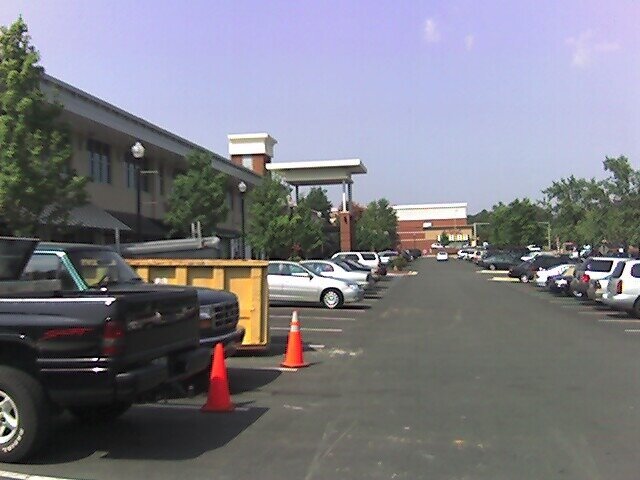
Existing Cameron Village parking with rendering of new premium parking.

North Carolina Loses The Great Teacher
 On the evening of Saturday, February 7, UNC lost perhaps its most important family member of the school’s storied history. Coach Dean Smith had suffered from dementia for many years, and his life ended quietly. The irony that such a sharp mind that steered so many storied comebacks would not be able to mount one in his own life is a bitter pill to swallow. That we are not in control of our fates is just one of the lessons Smith taught us.
There are hundreds of great stories being passed around these days about great Smith moments. Mine came after reading his book Multiple Offense and Defense. It is a fantastic, concise X’s and O’s manual for running several of the offensive and defensive sets Smith used in the first half of his coaching career. There are also great lessons about team play, running structured practices, acknowledgment of the groundbreakers that came before us, and the beauty of math in the game we love. That final point led me to corral my own stats for the team, which eventually blossomed into my website 20 years ago.
In the book Coach Smith explained his system for evaluating offensive and defensive efficiency, and stated that his team’s goals are to exceed 0.85 points per possession and to keep the opponent below 0.75 points per possession. The book was written before the advent of the 3-point shot, leaving me to wonder about how much that rule changed the stated goals. Woody Durham hosted a weekly call-in show with the coach and I was able to ask him my question on the air. He first stated,”Very good! You’ve done your homework,” then stated his updated goals of 0.95 and 0.85, respectively.
Apparently I’m not alone in being fascinated by the statistics basketball brings us, as evidenced by the popularity of Ken Pomeroy’s work. Pomeroy’s stats differ from Smith’s because Smith considered a possession to end when a field goal is attempted while Pomeroy considers it ending when the other team gets possession of the ball. Pomeroy reaches this figure by subtracting offensive rebounds from field goal attempts, making Total Possessions an irrelevant statistic. Smith’s method, on the other hand, leaves a Total Possessions differential which reflects the true rebounding, making his method much more useful.
When I was in Chapel Hill for college and dental school, I only had a couple of brushes with Dean Smith. One morning my dental class sat in a hallway waiting to take an exam. A hush fell on the group as Dean Smith walked down the hall by us after completing an appointment with one of our professors. It was as if we all wanted to be put into the game. We all got a chuckle at how we responded, but also were impressed that someone like Dean Smith thought that highly of our teacher.
I was lucky enough to get to sit behind the bench in ‘93 to watch the eventual National Champions play Duke on Senior Day. Committed recruits Jerry Stackhouse and Jeff McInnis sat in front of me while uncommitted Rasheed Wallace sat two seats toward midcourt. Wallace, of course, chose UNC over his hometown Temple, and Smith would later proclaim Wallace to be the best player Smith coached. The photo above is from the book Return to the Top, and shows me right behind Stackhouse and McInnis. Jim Valvano sat across the court doing his final full broadcast. Phil Ford, one of the greatest college basketball players of all-time, and Bill Guthridge, one of the best big-man coaches in the history of the game, were 10 feet in front of me. It was an incredible experience to be a spectator around these great masters of their craft. Of course from that angle one gets an appreciation of the vertical elements of basketball, but I was also able to appreciate the level of focus players from each team carried.
We essentially lost Coach Smith several years ago with the onset of dementia. Unlike other coaches, Smith retired and made few public appearances. In one of the many pieces of irony surrounding Smith, he was always proud of his ability to teach, yet could have taught us all so much about the game and life after retiring from coaching. Smith could be ruthless in team practices, slicing giants to pieces with his words. However those were players (and families) into which he had emotionally invested. He would never have felt comfortable criticizing the play of players he didn’t know, so he never pursued the chance to teach us more.
Smith learned basketball from Phog Allen who learned basketball from the game’s inventor, James Naismith. While Smith may be gone and the building bearing his name may not stand for the remainder of our lives, Smith leaves an indelible mark on both the game and the culture of the State of North Carolina through not only his bountiful coaching tree, but also through the many of us whose lives were enriched by his work.
History Making Heels and Wolfpack Prepare for Battle
With both NCSU and UNC coming off of thrilling home wins over Top 10 opponents, tonight’s showdown looks to be another great chapter in the rivalry’s rich history. Last year’s epic overtime battle was a modern era classic, and while many of the players return for tonight’s game, the primary factors are completely different.
The NCSU team has only recently found its identity. We knew they had a talented backcourt, but the the inconsistent play in the first dozen games really hampered the team. They keys to NCSU tonight are two-fold:
- While point guard Cat Barber continues to bring outstanding athleticism but sputtering smarts to the game, transfer Trevor Lacey has become an all-conference level performer. Nobody is talking about how Lacey can do everything that T.J. Warren could do, but the truth is, he isn’t far from consistently being that level of player.
- BJ Anya is a great shotblocker who is foul-prone. If he can stay on the court, NCSU’s frontcourt can match up to UNC’s.
State’s play is straightforward, but UNC’s is not. The first part of this 2015 season has been a trying one for UNC fans. The team, sporting with 6 McDonald’s All-Americans, has struggled to show any kind of cohesiveness and consistency. However dissecting the Heels reveals some things about this team that the babbling, mantra-driven local sports radio media fails to see.
- Against the 5th most-difficult schedule in the country thus far, UNC has held opponents to only 0.78 points per possession. That’s the best defensive of any UNC team in the 19 years I’ve tracked this statistic. That’s a period where the school has won 2 National Championships, been to 5 Final Fours, and put dozens of players into the NBA. The goal is to keep teams below 0.85, and this team is surpassing the stated goal by an impressive amount.
- UNC is averaging 4.5 more possession than opponents, the largest
margin in the tracking period, too. This means that this team is the best rebounding UNC team in the last two decades. - UNC is the #4 team in the nation in defending the 3-pointer (and that’s including the stats from the Notre Dame game).
- UNC is averaging 0.90 points per possession on offense. That ranks
#15 in the 19-year period. (goal is to be >0.95) - UNC is turning the ball over on 14.4% of its possessions. That’s a fairly average performance compared to other years.
- UNC is shooting 31% from 3, good for a #271 national ranking (345 ranked). They are #302 in 3 pointers made in each game.
With UNC’s weakness being outside shooting, one would think UNC would play to its strengths, however they are attempting 24% of their shots from beyond the arc. Usually Roy’s teams can shoot the 3 well, and only take about 22% of their shots from behind the arc.
The keys for UNC moving forward are establishing Joel Berry as the primary PG, moving Marcus Paige to the SG, narrowing the rotation, and running the offense through Kennedy Meeks.
Much attention is on Marcus Paige, however the statistics show that UNC falls apart offensively when Kennedy Meeks leaves the game. For UNC to win tonight, they need an excellent game out of Meeks, and to shut down the Pack offensively.
In the last 20 years NC State is 1-14 after beating Duke or UNC. I expect NCSU to struggle shooting the ball tonight, and for UNC to win this chapter. Revenge for tonight’s loser comes in 5 weeks, though, where NCSU may play their best Dean Dome game in quite some time. We’ll see…
25 Predictions for 2015
It’s that time of year. As a new one rolls around we look forward at the trends and events that will likely impact our lives in Raleigh. In no particular order, here is a glimpse into the crystal ball:
- 2014 was a banner year for electronic security breaches, and 2015 will continue the pattern. Banks and retailers, now facing higher than ever write-offs due to security breaches, will fully embrace cardless payments, and ApplePay will be huge. ApplePay is so secure and so easy, we will see iOS gain back some noticeable American marketshare from Android. A related technology we will see will be a payment by car; an ApplePay and Google Wallet extension in new cars allowing quick payment in drive-thru windows and turnpike tolling gates.
- As a result of new, secure payments and the end of predictable market corrections, we will see a solid year for brick and mortar retail.
- In food trends 2015 will be the Year of Cauliflower, and we will see it everywhere.
- Wake County will see sizable increases in property taxes and sales tax rates.
- Some Hibernian property will have a fire (they always do).
- After recently releasing their worst album, U2 will scale back their existing tour plans, and will not perform in North Carolina this time around.
- Raleigh will extend the route of its ever-popular Christmas parade.
- Raleigh will join in on the donut craze that has hit both Durham and Cary, with a donut shop opening in downtown or Hillsborough St.
- After much success with a seasonal store, A Southern Season will open a permanent store in Cameron Village.
- As with each year, we will say goodbye so some restaurants, but probably fewer old favorites than in 2014. Unless they are able to make changes to generate a serious amount of buzz, we are most likely to lose Zoe’s Kitchen, some Moe’s locations, Flying Biscuit (it will be a terrible year for Raving Brands), Crowley’s, Mia Francesca, Taj Mahal, and a few Subway locations.
- 2015 will be a huge year for straight-to-internet movies, and will be a difficult year for movie theater houses. Large movie complexes have less marginal overhead per screen-showing, so we will only see a slight reduction in their showtimes offered. However it will be very difficult for The Varsity in Chapel Hill to make it. Raleigh’s Ambassidor Cinemas, with 12 total screens over 4 locations, will likely scale back operations, too, especially at the Six Forks location.
- Publix will announce an alternate North Raleigh location.
- 2015 will see a surge of bluegrass-inspired local bands forming in Raleigh.
- 2015 will bring national exposure to Vivian Howard and her show “A Chef’s Life”.
- 2015 will be an off year, but nonetheless a strong one, for James Beard nominations in North Carolina.
- The Velvet Cloak property will be sold and plans to raze it and replace it with a mixed-use project will surface.
- Once again, Raleigh will continue its oppressive assault on drivers in neighborhoods by reducing speed limits on more wide, neighborhood streets to 25mph. They will also erect more of those contrived islands meant to annoy and slow drivers.
- UNC and NCSU will field bubble teams in football, once again, that will get absolutely no national attention.
- The entire KMart chain will close and RadioShack will close many stores in 2015. JCPenney will close many stores nationally, but the North Hill store will unfortunately remain open. (can you at least keep the lightbulbs replaced?)
- A new mall will be announced for the I-40/42/70/540 area between Clayton and Fuquay. It will focus on serving the Johnston County market.
- The Carolina Hurricanes will finish their worst season on record amid rumors of the franchise moving to Las Vegas.
- In downtown Raleigh we will see the closing of a Mexican restaurant and opening of a South American sit-down restaurant.
- In Men’s Basketball Duke will make the Final Four, UNC will lose in the Final Eight, and NCSU will not make the tournament.
- Due to legal pressures, hostile behavior by executives, a backlash against surge pricing, and taxi and lobbying powers, Uber will fail nationally (much like Aereo did).
- And in the world of dentistry: electric toothbrushes that log activity, much like a FitBit, will hit shelves and be quite popular, especially models designed for children and teens.
Raleigh’s 10 Biggest Stories of 2014
As we shut the door on 2014 we take a look back at the stories of 2014 that will have the biggest impact on Raleigh moving forward (in no particular order of importance):
Mitchell Silver leaves Raleigh for NYC
Mitchell Silver, Raleigh planning director for the past 9 years, accepted what he calls his final job when he got a call from NYC Mayor Bill de Blasio. Silver will serve out the next 4 or 8 years as New York’s Commissioner of Parks, an intends to retire to Raleigh afterward. In his 9 years Silver laid out two comprehensive planning planning strategies, but also executed some masterful microdesigns that have made downtown Raleigh a more unified, walkable, and livable place.
State and Federal Elections (aka “Moral Monday Backlash”)
The state’s NAACP director organized some well-attended, disruptive demonstrations at the state legislature. Not only did these actions affect no change with legislation, on November 4, voters across the state chose to continue the Republican super majority in the state houses.
Wake County Democrats Take Supermajority
Probably the most surprising and most impactful story of 2014 was the Democrats’ sweep of Wake County Commissioner seats, taking every seat on the board. There are 24 elected seats in Wake County and 21 are held by Democrats. While most didn’t expect a full sweep in a vacuum, the biggest surprise is that it occurred on a day where nationally Republicans had one of their best election days in recent memory.
Tupelo Honey Opens in Cameron Village
There has been a lot of fuss over Tupelo Honey in Asheville, and the restaurant’s most recent expansion was into Raleigh. Raleigh’s best new restaurant came at the end of the year, and it has been packed since Day One.
Thomas Crowder Dies
One of the key members of Raleigh’s Democrat-led City Council died after a somewhat short battle with testicular cancer. Crowder was a part of the Meeker-led bloc that spearheaded changes in Raleigh’s downtown and suburban development. His seat is filled by his surviving wife, Kay.
Fortify Project Begins
The three-year plan to dig up I-40 and I-440 from Poole Road to the Crossroads interchange got in full swing, leaving drivers waiting through delays and finding alternate routes through southeastern Wake County.
Wainstein Report Released/UNC Scandal Grows
2014 was the worst year in UNC’s 219 years of history. What started as a scandal about football improprieties grew in 2014 taking down UNC’s academic reputation with it. UNC Chancellor Carol Folt commissioned an investigation into academic wrongdoing in the AfAm department. The results showed, however, that non-athletes were in the majority of those receiving sham credit hours, and from multiple departments. The NCAA re-opened their investigation into the matter, however we still await its conclusion and response
Ashley Christensen Wins Beard Award
There have been many great years recently for Raleigh chef Ashley Christensen, but 2014 has to be her finest yet. In early May she was named the Best Chef in the Southeast by the James Beard Society. Christensen not only saw her existing restaurants strengthen their bases, but she also announced the planning of a new restaurant, Death & Taxes, and opened a commissary to run back-end food prep for her family of restaurants.
Triangle Flexes Culinary Muscle
While it was a banner year for Ashley Christensen, it was a fantastic year for the entire Triangle. Out of the 433 national nominees for James Beard awards, 9 were in the Triangle area, joined by 3 others from the rest of North Carolina, totaling 12 for the state. No restaurants from Charlotte, the Triad, or Wilmington were nominated. Only 6 nominees went to each Virginia and South Carolina, while 11 went to Georgia. Much ballyhooed Austin, Texas? They got just 3.
Snow Cripples Raleigh, Frightens Duke
On February 12 Raleigh got an icy 3 inches of snow, causing severe traffic problems. When one untalented driver on highway 70 revved the engine too high causing the engine to burst into flames, the ensuing mayhem on eastbound 70 in front of the Angus Barn became fodder for a .
Duke was to travel to Chapel Hill to play in the Dean Dome that night, but Mike Kryzyzewski feared problems traveling on 15-501, and canceled the game. With everyone else in place to play the game, including ACC referees and TV crews, many speculated that K was trying to protect his team from embarrassing themselves on national TV. The game was postponed and UNC still won. Duke saved the embarrassment for March 21 with a first-round NCAA Tournament ousting at the hands of Mercer.
2014: The Rain Year
One of the most underreported stories of 2014 is the enormous amount of rain that fell on the city in the second half of the year. Without a tropical storm or hurricane to inflate annual totals, as we typically see, Raleigh still got 55.29” of rain. This is 11.95” above the normal 43.34” annual total.
I am not privy to historical rainfall totals for this area, but being 28% above the normal level is exceedingly rare, and likely greater than 2 standard deviations away from average. By comparison 1996, a famous year which brought two hurricanes to Raleigh and featured a September with 16.65” of rain alone, had a total of 59.14”, a total 36% above normal. 2014 however was a year which had normal rainfall for the first half, then about seven large dumps throughout the entire late summer and fall. It was an unusual pattern that will certainly have an effect on root and mold development through the coming winter and spring.

image courtesy
2013 Predictions. A Look Back
23 months ago I posted some predictions for the upcoming 2013 year. For fun, let’s look back and see which ones turned out and which ones didn’t:
- Publix will begin construction on their first Triangle store…in Cary in the Davis/54 area. TRUE (kind of) – The store opened at Davis Drive/High House a couple of weeks ago. Not 2013, but I got the location correct!
- Publix will pick Creedmoor/Millbrook for their first Raleigh store location. The new owners of Falls Village will make a strong play for Publix, offering to raze half of their center to accommodate a large grocery store. – WRONG – Publix is, however eyeing a North Raleigh site near Bedford for their first Raleigh store
- Raleigh will begin discussions to tear down Memorial Auditorium – with the dominant bookings of the DPAC, Raleigh people are increasingly irked by having to go to Durham for so many good events. Leaders in Raleigh will talk about removing the center section of the performing arts complex and replacing it with a stacked, 3-tier facility to compete with the DPAC. – WRONG – Memorial Auditorium’s HVAC system was renovated this summer, but the house continues to struggle against the nationally-renowned DPAC. Give this one a few more years, though.
- Violence will be an increasing problem in Glenwood South, and patrons will start seeking another focus for nightlife, most likely in…the Hillsborough Street area, which will be the next wave of downtown revitalization. WRONG – We having seen a big uptick in violence, thankfully. However we are seeing a big movement toward residential space on Hillsborough, and retail will follow.
- Orvis will close in Triangle Town Center and seek space in a part of the Triangle where their patrons actually live. Perhaps Kidd’s Hill behind Crabtree? WRONG – The store is still a ghost town, though.
- Development of both Kidd’s Kill properties will finally begin, but the Soleil Center/Westin land will remain an empty lot. CORRECT – A very disappointing apartment development is going in behind Crabtree, and the Soleil property remains a fenced off eyesore.
- A new mall will be announced for the I-40/42/70/540 area between Clayton and Fuquay. It will focus on serving the Johnston County market. WRONG – Still waiting on this one.
- Best Buy will close at least one Triangle location. My bet is the newest store, Brier Creek. CORRECT, KINASORTA – Best Buy is hanging in there, but they did close the store across from Triangle Town Center, and opened a small footprint store farther into Raleigh on Capital Blvd.
- Between Liles, The Varsity, and Nowells, Raleigh will only support two, and one will close. – CORRECT – The Varsity closed
- As brick & mortar retail continues to struggle, Crabtree will add another restaurant in its mall proper CORRECT – Tomato Pie opened in the mall’s lower level.
- While Washington policy will grow much more liberal than we’ve seen in the previous 4 years (increasingly hostile fiscal policies toward the wealthy, increased spending on social programs, and a stark increase in liberal social policies and transit expenditures), North Carolina policy will become more conservative, but not by much. In the next four years issues like Gay Marriage, Legalization of Pot, and Gun Control will stay put in this state, unless there is federal mandate… MOSTLY CORRECT. The wealthiest 1% now pay 24% of the Federal Tax burden, and NC’s policy has stayed conservative. (See Gay Marriage in next comment)
- …The Supreme Court will rule that Gay Marriage must be recognized by all states, and Federal Legislation implementing more stringent gun control will override North Carolina’s stance. WRONG METHOD – NC did, in fact, legalize Gay Marriage without a federal mandate, and the issue continues to be challenged in court by conservatives.
- North Carolina will get an increased amount of funding for transit (regional “high” speed and local light rail), but the State of North Carolina will decrease expenditures in these areas, and no real progress will occur in the next four years, especially with light rail. WRONG-SORT OF – We didn’t see appreciable funding for transit in 2013, but in early 2014 a light rail project linking UNC and downtown Durham was approved by federal agencies.
- Raleigh will continue its oppressive assault on drivers in neighborhoods by reducing the speed limit on Glen Eden to 25 mph. They will also erect more of those contrived islands meant to annoy and slow drivers. WRONG/CORRECT – Glen Eden remains untouched, but we have seen the introduction of speed bumps and arbitrary 4-way stops on streets like Northbrook Drive and Lake Boone Trail. Contrived islands, surprise curb extensions, and traffic circles are planned for Currituck Drive.
- UNC and NCSU will field bubble teams in football, once again, that will get absolutely no national attention. CORRECT/INCORRECT – UNC went to the game in Charlotte and NCSU did not win a conference game in 2013. Neither, however, improved their national stature in football.
- If the NHL season is cancelled, Backyard Bistro will close. N/A – The NHL season was not cancelled in 2013.
- T-Mobile will be bought by one of the other carriers, most likely AT&T, reducing the number of carrier networks to three in the Triangle. WRONG – There are still 4 carriers, and T-Mobile has survived by reducing the 2-year lock-in contracts that became the norm.
- Free Wifi will be everywhere by the end of the year. In the malls, the restaurants, and in grocery stores. Most importantly, I predict that free wifi for every fan in the building will be implemented in the PNC Arena. (yay!) WRONG – Slowly, but surely, we are getting there, though.
- The number of restaurants with tablet menus will grow quickly. In fact, only cheap or snobby restaurants will be without a tablet presence by the end of 2013. CORRECT/KINDA – iPad lists have been a big hit for extensive wine lists, and we have seen table-top kiosks appear in Chili’s, however digital menus are still in the minority.
- Buca di Beppo will announce their first Raleigh/Cary location WRONG (sniff)
- PDQ will announce two more locations. One in the Southpoint area and one in Cary. WRONG/CORRECT – PDQ did add two more locations, and one is in Cary. The other is in Wake Forest, not Durham.
- One of downtown Raleigh’s Indian restaurants will close. Will it be Blue Mango or Mantra that survives? WRONG
- BJ’s Brewhouse will announce their first North Carolina locations – on in Charlotte, one in Cary. WRONG
- The next big culinary ethnicity, after Mexican starts to fade, will be South American. Restaurants like Machupicchu and Guasaca will have excellent years, but will see more competition, too, especially in the casual dining space. N/A – We really haven’t seen a replacement for Mexican yet. Still waiting on this one.
- Guacamole variations will be the next trend within the Mexican food space CORRECT – Many Mexican restaurants offer varieties of Guacamole.
- The IHOP on Hillsborough Street will close, but will be replaced in 2014 by a mixed use apartment building that will have street level retail, including a new IHOP. (This is a planned project. The prediction is that execution will begin this year) WRONG TIMING – Still waiting on this.
- The Triangle will be selected as the site for filming a nationally prominent movie. WRONG
- No significant changes to Raleigh’s skyline will be introduced in 2013. WRONG – Skyhouse apartments began construction in 2013, and other projects on that block were proposed.
- A MakerBot-like 3D printing business will open in Raleigh, allowing people to create functional and artistic plastic items just-in-time. N/A – Maker projects are growing, but we having seen private 3D printing places yet.
- Here’s the big one: 2013 will be the Year of Durham, and the crowning moment will be an announcement by Google that their second Google Fiber city will be…Durham. KIND OF CORRECT – Google put the entire Triangle on its short list for fiber, and AT&T announced fiber expansion in the Triangle, too.
So, overall, not too bad. There were some correct predictions, and for the most part, the incorrect ones were not way far off. Some just need more time as the sluggish economy still has lending markets feeling jittery.
In one month I will present predictions for 2015.
DOT Unveils I-440 Widening Plans
Today the NC Department of Transportation held an information session regarding the I-440 widening plan. Construction on this final piece of “The Beltline” to offer only four lanes, is slated to break ground in 2018, and will likely take two years to complete.
involves Interstate 440 from the I-40 interchange at Crossroads (The Belt Buckle) to the Wade Avenue interchange. It is a stretch that is only 3.75 miles long, but has a significant number of difficult challenges from replacement of all bridges to dealing with terrain problems to overcoming constrictions set by limited right-of-ways.
Let’s look at the key elements, moving from North to South:
I-440/Wade Avenue Interchange
The existing problems with this area lie with a heavy traffic load in the afternoon on the ramp from inbound Wade to 440 Eastbound (440E), a short weave under the bridge on Inbound Wade, a short weave on 440E between Hillsborough and Wade, and a short weave on 440W’s bridge over Wade. Planners intend to solve the first two problems by replacing the Wade/440E loop with a flyover bridge. Dealing with the other problems gets extremely tricky, but each plan has one other common feature: the elimination of the Outbound Wade/440W loop. ITB drivers wanting to go to Cary will have to make a left turn after the 440 overpass at a traffic signal. The other options mainly deal with getting traffic on/off of 440E to/from Hillsborough and Wade; the segment bordering Meredith College.
One Flyover
 This option puts all traffic coming from Cary onto a 2-lane resurrected loop on the NE corner of the cloverleaf. Traffic headed inbound on Wade waits at a left turn signal while traffic headed outbound continues from the loop into Wade. Hillsborough Street traffic headed out Wade blends with offcoming 440E traffic while cars getting on 440E dives under a new offramp bridge.
This option is the least expensive and offers Hillsborough Street drivers an unimpeded path to Wade Outbound and puts traffic directly onto Wade Avenue (see Two Flyovers). The main problem is that it keeps an unnecessary traffic signal stymying both directions of Wade. Why not keep the off-ramp for Inbound Wade traffic, give outbound their loop, and eliminate the current traffic light?
Two Flyovers
 The Two Flyovers option takes traffic on 440E headed to Wade Outbound on a flyover that would merge with offcoming 440 West’s heavy traffic, before merging onto Wade. Traffic headed inbound on Wade uses the current offramp and right turn.
The option makes all traffic coming from Hillsborough have an easy route and removes the existing traffic signal at Wade Avenue. The option keeps speeds higher, reducing bottlenecks, supposedly.
Actually this option would be an expensive nightmare, as then all 440 traffic headed to Wade Avenue west would have to merge with each other as well as short-weave with Wade Avenue traffic before the Blue Ridge Road offramp. Because the Blue Ridge Road offramp is not a part of this project, it cannot be changed and introduces a severe problem with the Two Flyover plan.
Slight Detour
 The Slight Detour plan takes 440E traffic headed out Wade through a resurrected 1-lane loop on the NE corner of the intersection. 440E’s Inbound Wade traffic and all of Hillsborough Street’s traffic would proceed to the current Wade Avenue signalized intersection, where Wade Inbound, Wade Outbound, and 440E can be accessed.
This plan handles the 440E to Wade Outbound traffic beautifully, as the traffic merges onto Wade before 440W’s offramp merges. The plan puts a weird burden on the Hillsborough-borne traffic however.
The strongest option of the three, as drawn, is the One Flyover because it keeps traffic from Hillsborough Street flowing best, however an Inbound off-ramp would be the best option as it removes an unnecessary traffic light from Wade Avenue’s flow.
I-440/Western Blvd
 Raleigh is about to get its first Diverging Diamond Intersection (DDI)! The DDI takes the Western Blvd traffic and swaps sides of the road near the 440 overpass. Each swap is managed by a 2-stage traffic signal, making the intersection easily traversed by pedestrians while keeping Western Boulevard’s traffic flowing well.
DDI intersections are strongest because the swap allows extremely safe, easy left turns onto and off of the highway’s ramps. Initially some are terrified at the thought of swapping the sides of the road, however these intersections are well marked and really feel like a one-way street. They are no scarier than a SPUI interchange, like the one at Southpoint Mall on I-40.
I-440/Jones Franklin
 The current problems with this intersection are a double traffic light on Jones Franklin (because in the 70s a new apartment complex was allowed to access the road 50 feet from an off-ramp intersection), an extremely dangerous pedestrian situation on the overpass, a short weave on 440E between I-40 and Jones Franklin, and 440’s shortest onramp (Jones Franklin onto 400E).
Where do we start? To begin with, the 440W offramp will be realigned with the apartment complex’s street, creating a single signal intersection. Engineers intend to use a weave (bridged swap) to avoid the current short weave between I-40 and Jones Franklin on 440E.
The realignment will improve dramatically the intersection on the north side of the interchange. The weave? I don’t see much of a problem with the current short weave, and don’t think it needs to be addressed.
One problem, however, with the plan is that it shows Jones Franklin with four northbound lanes between the traffic light and Waters Edge. There is currently a northbound TTA bus stop in that segment (green dot). As designed the TTA bus would have to accelerate across two lanes of traffic through a T intersection after loading passengers.
When I proposed moving the stop to the south corner of the ramp/Sumter intersection (blue dot), the DOT engineer laughed in my face. No way is NCDOT going to allow a bus stop in their intersection, apparently. I was stunned, and appalled, in fact. The proposed intersection could easily be marked with crosswalks and signalized to handle a bus stop before the intersection. It is a far more safe manner than the engineer’s proposal of keeping the stop where it is.
I-440/I-40
The “Belt Buckle” is an intersection needing much improvement. Traffic merging from Crossroads Plaza has to traverse 2 lanes of traffic still hot from a 65mph speed zone. There is a short merge under the 40 bridges, and it creates backups on the US1 North segment of road.
DOT proposes a flyover for 40E traffic headed onto 440E. The plan removes the current loop for this move and solves the short weave problem under the bridge. Seriously, though, who does this move? Of the cloverleaf’s options, that’s probably the least utilized option. If all other things are equal, the flyover should be for traffic moving from US1N onto I-40W. Environmental and legal constraints apparently prohibit DOT from obtaining this land. (I haven’t written about this yet, but David Martin has wanted, for years, to put “Crossroads Towers”, 4 office towers and a hotel ranging from 10-62 stories each, on that land. Stay tuned).
Even more interesting about this intersection, however, is that there is a feasibility study going on right now to examine redoing the entire 440/40 intersection. In other words, a comprehensive overhaul may be coming anyway for this intersection, which means that DOT will likely take the options to just widen 440 to 40 and not touch the intersection for this project.
There are other aspects about this project that don’t require much discussion. The Melbourne Road bridge will be replaced, and the intersection will not close, for instance. DOT also plans to keep Method connected to a cemetery in the shadows of Westgrove Tower, as well.
* * *
However the four big interchanges are the story here. Interim routing will be fascinating, as major changes such as those proposed will require an exquisite amount of detouring during the project.
County Power Shift Brings Major Changes to Raleigh’s Future
 Having a multi-tiered government means that every election brings a new character to the way we are governed. Tuesday night’s results certainly lived up to that promise, bringing significant changes to Raleigh.
I’ve always felt that the best place for Liberalism is in local government, where government application can best be managed and tailored for its citizens’ needs. Conversely the best place for Conservatism is in Washington, where one-size-fits-all governing rarely works.
Tillis Defeats Hagan
Surprisingly, outgoing N.C. House Speaker Thom Tillis defeated the incumbent senator, Kay Hagan. The results for this race, along with Virginia’s, became the primary focus of national election coverage last night. The win for Republicans added to the party’s newly-gained majority in Washington, leaving President Obama relatively powerless against the Republican-controlled Capitol chambers.
In the end, however, the N.C. Senate race was a red herring for Raleigh residents. At the time of this writing Republicans will have a minimum 4-seat advantage in the U.S. Senate. The Tillis-Hagan race’s timing is being hailed as the race that put the Republicans over the edge for control. However the reality is that over $110 million of money was wasted on a race that means nothing to Raleigh.
Had Hagan won, she would have been a powerless observer in Washington over the next two years, unable to address North Carolina’s concerns. With Tillis’ win, he will be a powerless follower, but perhaps North Carolina’s interests will be better represented with both of its senators being in the same party as the majority and the state’s governor.
One thing that certainly will change for Raleigh residents is the way we watch TV and use the internet. Net Neutrality is dead from this election, so buckle up as internet service providers (ISPs) start to offer “free” or “faster” downloads for their content. I use those terms loosely because what will actually happen is your ISP will download data from competing entertainment companies at very slow rates, maybe even charging you extra for these data bits.
An example of this is your ISP charging a “Netflix surcharge” because you aren’t watching movies the ISP offers. We already are seeing this with “free” music from Rhapsody for T-Mobile users. In actuality they are charging you for music downloads from other companies.
Don’t be surprised if we see the introduction of metered data for home internet, too. ISPs know that Netflix is straining their servers at night, so they intend to pass along the costs of extra capacity. One way to do this is to limit the data you use during those period…unless you pay them extra.
Republicans Maintain Control of Both State Houses
A more important result for Tuesday’s election is the continued control of the state’s government by the Republican party. While some Democrats pulled off upsets, it was still a night where even Democrats with highways named after them lost.
The result was a statement of disapproval by the people against Reverend Barber’s Moral-killing Monday demonstrations. For some reason demonstrators thought they had an effective way to win back control of the state’s government; a message that Republicans hate teachers, minorities, and women. However The People turned out heavily for this midterm election sending a somewhat strong message of support for the current legislature.
Democrats Take Unprecedented Control of County/City Government
Lost in all of the hoopla over the senatorial race was the real story from last night. Not only did Democrats win a voting majority of the Wake County Commission, they have every seat on that commission. In fact, of the 24 main governmental seats in Wake County, 21 are owned by Democrat winners. Only 2 are Republican and 1 an “Independent”.
Perhaps the most interesting aspect of the entire election is the disparity in government control on the national and state levels with the local government in Raleigh. As I stated earlier, this is probably the best structure for the grand scheme of things, and will definitely be a fascinating study over the next 24 months.
* * *
How Will Raleigh Change?
The Democrat’s sweep of the Wake County Commission was primarily led by the Sig Hutchinson campaign. The announced agenda for the election by his team focused on five areas:
Schools
Wake County should see a big push for increasing teacher pay and building new schools. With no resistance, we should see a reversal of the conservative-led movement away from busing a few years ago.
Transit
For over twenty years Raleigh has tried to organize a plan for “mass transit” (high-occupancy rail transit) and hasn’t been able to gain any decent funding beyond Planning and Land Acquisition. That all changed yesterday, however, as Wake County’s commissioners will get serious about developing a rail transit system. With the approval of the Orange/Durham light rail plan by the Feds back in February, Raleigh and county leaders feel like the city has fallen far behind in planning. There will be a huge push toward getting ground broken as soon as possible, regardless of costs.
Parks and Greenways
Parks and greenways seem to win every bond referendum, and this year’s bond victory is no different than others. Expect to see continued development of greenways paths, especially in outlying areas of Wake County. However the biggest change we will see is the realization of . With the county and city behind this, there is finally political pressure to make the Dix Park dream a reality.
Water and Environment
Expect a big change in wastewater treatment, as storm water runoff and sewage are going to play big roles. Whether we see the return of a garbage disposal ban or water use restrictions during abundance is yet to be determined, however you better save those plastic bags from the grocery store because they will likely be banned in Wake County. We may also see development of larger water reservoirs, however the big push from this group will certainly be on the conservation end.
Jobs and Economic Development
We can expect a big push for arts-oriented and computer lifestyle jobs. Too, we should see a big push in transit-oriented development and infill projects, and a de-emphasis on sprawl-oriented, land-clearing projects.
How Will Raleigh Pay For This?
The new agendas in transit and schools will be extremely costly, and is not achievable with the current tax structure. With Republicans holding the federal and state purse strings, there will be a sense that Wake County should try to fund as much of this as possible locally. This makes sense, actually, given that we are the the benefactors of a system. After all, it isn’t Peoria’s responsibility to pay for our light rail system.
Residents should plan for steep (>20%) increases in property taxes. A hotter political item, however, will be a necessary sales tax increase. Currently Wake County is one of the 71 counties with the lowest sales tax rate in the state, 6.75%. The highest sales taxes exist in the transit-taxed Durham and Orange (7.5%) and Mecklenburg (7.25%). Wake County residents should prepare for a sales tax of at least 7.5%, however 7.75% is likely to be proposed given the perceived need to “catch up” with other counties’ transit plans in light of absent federal and state funding.
Usually it takes time for sift the meaning of elections. In Washington the unpopular President Obama will have to figure out (perhaps borrowing from President Clinton’s playbook) how to legislate with the opposing party controlling both the Senate and House. Locally, however, the future is clear. We’ve seen what Raleigh City Council leadership wants over the last 10 years wants, and over the last year we’ve seen what the Wake County School Board wants. Now that their county-level restrictions are gone, and we will see all three bodies start to stretch their legs very quickly as they steer Raleigh forward.
Download the Wake County Schools’ 2015 Calendars
 Wake County School System has compiled their official calendars for the 2014-2015 school year . In fine fashion gogoraleigh has converted all of these calendars into numerous downloadable formats.
Now readers can easily import their favorite school calendars into Android phones, iPhones, Outlook, and more. The set includes calendars for the Traditional, Track 1, Track 2, Track 3, Track 4, and Modified schools. Even better, if you already subscribe to any of these calendars, then all of the new dates have been automatically added for you.
For more information and downloads, see the Calendars tab at gogoraleigh.
Maybe the Foxes Are Sending “Triangle” a Message
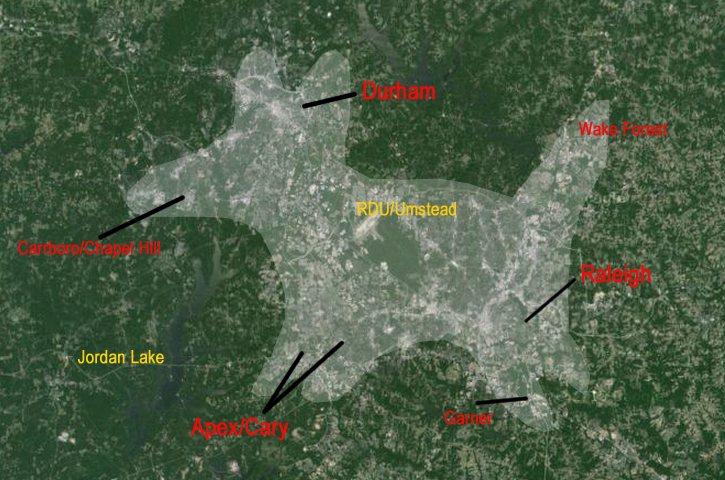 For five decades now the Raleigh/Durham/Chapel Hill area has been termed “The Triangle”, and for good reason. As three cities/towns hosted the most important academic, medical and business centers, it was only natural to focus on the three entities. While we expected infill in The Triangle, we perhaps didn’t see our grown concentrations morph the area into a different shape; .
The area’s satellite imagery reveals much growth from Chapel Hill and Carrboro toward Raleigh, but Raleigh’s growth has been along outward spokes to the northeast, southeast, and southwest. According to the figure, Umstead park appears like a saddle on the little fox, and Jordan Lake looks like a long line of droll from Carrboro/Chapel Hill, the mouth of the dog.
While I’m not assigning any character traits to communities based on this morphology, the shape does spur some interesting questions such as:
- Why hasn’t Creedmoor Road/hwy 50 seen any retail development?
- Why has the Apex/Garner axis been kept so rural?
- Why has the Durham/Wake Forest axis been kept so rural?
Maybe these little red foxes that are invading our cities are simply a calling; the new mascots for the area. Instead of “The Triangle”, we could be called “The Fox”. The airport code could be changed to “FOX”. The 10 o’clock news could be the Fox News Hour….oh wait.
Need Help Discovering Great Cookbooks?
If you have ever found yourself overwhelmed in the cooking section of a bookstore or at Amazon.com, you aren’t alone. There are hundreds and hundreds of cookbooks out there and it is difficult to discern the good from the bad.
One of the best ways to improve your cookbook collection is to look at what cookbooks the great chefs are using. One of the most exposed and interesting selections in the area is at Rise, the biscuit/donut shop in the Southpoint mall complex. It’s a fun look; rewarding to see some of your favorites, but also a great chance to add to your own list or your gift lists.
[imagebrowser id=22]
Recent Stories
- City Lays Markings for Currituck Obstacle Course February 4, 2015
- History Making Heels and Wolfpack Prepare for Battle January 14, 2015
- 25 Predictions for 2015 January 5, 2015
- Raleigh’s 10 Biggest Stories of 2014 January 2, 2015
- 2014: The Rain Year January 2, 2015
- Tupelo Honey Sets New Casual Standard December 1, 2014
- 2013 Predictions. A Look Back November 18, 2014
- Wicked Taco Bringing Fresh-Mex to Western Blvd November 17, 2014
- DOT Unveils I-440 Widening Plans November 12, 2014
- County Power Shift Brings Major Changes to Raleigh’s Future November 5, 2014
- Jarrett Bay Store Coming to Crabtree September 25, 2014
- FirstWatch Coming to Glenwood Avenue September 9, 2014
- Big Shindig Releases Set Times September 5, 2014
- Appearance Commission to Review Residence Inn September 3, 2014
- Raleigh to Host Farm Aid July 24, 2014