
N.C. State Fairgrounds Releases Master Plan
 The 2/4/09 draft of the master plan for the North Carolina State Fairgrounds by HH Architecture has been online a little while. Plans seem to call for expansion of the Kerr Scott building, and new exposition buildings behind Scott and next to the new expo building (hopefully with better lighting and interior paint colors). The dramatic changes with the main campus involve a complete redesign of the garden club space and Village of Yesteryear areas. If appears the several new buildings will replace those standing to create the Agricultural Museum Complex. Adjacent to the West Gate will be a new Holshouser Building as well as a gondola that will connect to the east side of the fairgrounds, near the restaurant row, which is slated for removal. Additionally the grandstand will be removed when a new grandstand is built far behind the Scott building, near Trinity Road.
In addition to the main campus changes, massive improvements for the Hunt Horse Complex are proposed, adding 8 barns and 4 show areas.
The pdf files don’t convey a specific timeline for the projects. This is more of a 20-30 year master plan. Nevertheless it is good to see the vision planners have for this property.
- Overall (pdf)
- Main Campus (pdf)
- Hunt Horse Complex (pdf)
- Western Property (pdf)
- Property Areas (pdf)
- Existing Property (pdf)
- Aerial of Fairgrounds (pdf)
Survey Aims At Moore Square Design
I got an email from a couple of people who are working on Moore Square redesign submissions, and they would like for everyone to help them by taking a very simple, quick survey. Please take a minute and help them collect some data!
Bank Of America Installing Drive-Thru ATMs at North Hills
The way North Hills mall approaches the intersection with Lassiter Mill Road has always created an odd triangle of land. It has been used as a small overflow parking lot and a staging area for North Hills construction projects. Earlier this year Bank of America moved from of its doomed building across Six Forks from the fire station to the space in North Hills next to Total Wine. The problem with that space is that it doesn’t provide for drive thru tellers or a convenient ATM.
Construction recently began on the little triangle of land and yesterday it was revealed that it will be remade to house a pair of drive-up ATM machines. While the location is not ideal given its distance from the BOA branch, it is a clever use of a forgotten piece of land that, for over 40 years, nobody has put to good use.
24-Hour Diner Coming to Glenwood
TBJ is reporting that the former Hard Times Cafe spot will soon be overhauled and will open as The Diner. It will be the latest concept by Niall Hanley’s Hibernian Company, the group that brought The Hibernian and Solas to that area. The Diner will open in the fall and will be a 24-hour American fare joint.
Converse With Leaders About Growth
On Wednesday night, WakeUP Wake County is hosting “A Conversation on Growth and Development in the Triangle”. Please join me and other local young professionals at Sitti in downtown Raleigh for drinks, appetizers, networking and an conversation with:
- Greg Hatem, Empire Properties and WakeUP Board Member
- John Kane, Kane Realty and redeveloper of North Hills
- Mitch Silver, Raleigh City Planning Director
- Melanie Wilson, former Wake County Planner
The event occurs on Wednesday, July 1 (6 pm for drinks; 6:30 for the panel discussion) at Sitti Restaurant, 137 S. Wilmington St., Raleigh.
The event is sponsored by Emerging Tar Heel Leaders, Sitti, Mez Restaurant, and WakeUP Wake County.
This Teardown Hits Home
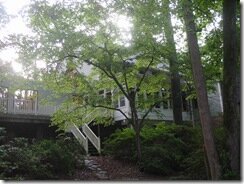
 Raleigh’s newest teardown is at 428 Drummond Drive (map it). The house was built in 1976 and had just over 4,000 square feet plus an unfinished, almost full basement. There were 4BR/3.5Baths, walk up attic, walk-in closets for all bedrooms, upstairs utility room, and 9’ ceilings downstairs. The .93 acre lot backs up to The Greenway, just across Crabtree Creek from St. David’s School. The house is currently being torn down and will be replaced in the next year. Why do I know so much about this house? It is the house in which I grew up.
 The surgical disassembly of the house has been interesting. Habitat For Humanity volunteers went in and salvaged nearly every possible component, including doors, windows, electrical wiring, plumbing, and more. After complete removal of all insulation and wallboard, non-essential walls were removed and the wood was salvaged. As the removal of the roof progresses, it seems the deconstruction company is salvaging the mighty joists for the house’s tall roof.
 For the record, I have been and still am a supporter of Renew Raleigh’s principles of homeowner’s rights. After being on the market for well over a year, the house finally had a buyer, and he owns the rights to do whatever he wants to with the property. I fully support him in making that address a fine home for another family in the future.
It is quite surreal to see the house come down, though. My mother was the general contractor as the house was built all through the summer after I finished First Grade. As my daughter finishes her own First Grade year, she will see it come down.
Several factors went into the house’s demise. After we lost my father two years ago, it was emotionally the right time to leave. The house, built for a family of four, was not the right place for a widow living alone. It was just too much for one person (and frankly, whoever lives in the much-bigger replacement will have to spend a lot of time/money washing windows, maintaining that yard, cleaning bathrooms – I don’t envy them!). I think the timing of my father’s death was about as bad as it could have been given the slumping real estate market. As the house sat on the market, we all got the feeling this would happen.
 I feel like I have a realistic handle on the situation. Let’s face it, on a street full of all-stars, this house was not the street’s finest. Despite needing some TLC, in the grand scheme of things, it was a fine house. Perhaps the biggest enemy of the structure, though, is the property on which it sits. A lot backing up to a nature preserve, in one of Raleigh’s safest ITB neighborhoods, with absolutely no chance of having the setting spoiled by new development is a rare find. These factors presented opportunities for the site that badly outweighed a house with yesterday’s styling and in need of some repairs. It is a similar quandary to the Paschal House in Country Club Hills. Its large lot will eventually be subdivided and the house will be sadly removed, too.
 While it is never a joyous occasion to lose a landmark in one’s life, the most disturbing aspect of this “scrape” is that this house simply wasn’t good enough, in this day and age? Really? We have a president who recently proclaimed the economy as the country’s worst since the Great Depression. Mind you that was an era where some lost so much that they had a hard time finding food. Our dire situation juxtaposed against the discarding of a pretty nice, big house is difficult to reconcile with the real world.
To make matters worse, the house in which my family lived before we built this one was also torn down this year. It was a house that had problems, and its demise didn’t surprise me. Seeing my only two childhood houses I can remember coming down has been a totally bizarre experience to say the least. Hopefully it will remain a rarity in our society.
Certainly history will offer a full perspective on this and similar situations. Do we prefer that people craving big houses go to Raleigh’s outskirts and advance sprawl or replace our aging structures that do not meet the demands of the market?
 The value of “stuff” in our lives is forever redefined. A seminal moment for me, however, was during Hurricane Fran. I stayed in the house with my parents the night of Raleigh’s biggest hurricane. After hours of hearing pounding rain and tall trees falling nearby, we heard a big pine hit the house. Boom, boom, boom it went as it grazed the chimney and the downward sloping far roof edge. As Fran’s eye passed, we ventured outside only to find my 1-year old BMW crushed by three trees.
As the car lay squished like a bug, I felt a strange calm. It was just a thing. Houses are no different. Memories are inside our heads, not in buildings. Our values as a society will ebb and flow, but our interactions, experiences, and accomplishments are what make our lives whole. R.I.P., 428. May your parts continue to fulfill others with great opportunity in this world.

Hotel Possibly Planned for Glenwood South
 According to the agenda for an upcoming Board of Adjustment meeting, a 9-story hotel is being planned for the corner of Glenwood and West Johnson Streets in downtown Raleigh. The lot is currently occupied by the Abbey Carpet store, across Johnson Street from Red Room. The variance is being requested because of an appeal by the property owners for a variance to the 1|1 stepback for buildings in excess of 40 feet. Plans for this 80-foot building call for no stepback. While mixed-use has been a commonly used development scheme for lots this size, Raleigh certainly needs more downtown hotel space, and rumors point this way. The meeting takes place on Monday morning, June 8.
Site Four Goes Back to Square One

The protracted saga for Empire Properties’ current Site Four plan is over as the Raleigh City Council adopted the city manager’s recommendation to terminate the contract regarding the property. The meeting’s agenda, released last week, shows:
On August 5, 2008, the City Council agreed to amend the Development Agreement with Empire Properties regarding the development of a boutique hotel and residential project on
the property known as Site #4 at the corner of Lenoir and Salisbury Streets. The amendment adjusted the allowable uses on the site and re-set the development milestone calendar to allow a four-month extension of the previously agreed-upon development milestones. This amendment also included an agreement to share costs for the widening of Salisbury Street and an agreement not to seek any further extensions to the milestone calendar. The developer has missed milestones in April (Building Permit Approval and Real Estate Closing), and clearly will miss the construction start date in May. No
substantial action has taken place on the preliminary approval of the project since late last
year. The developer indicates his desire to continue to work toward developing the
project, but in the current lending environment cannot commit to a specific time frame.
Recommendation:
a. That the City cancels the Development Agreement with Empire Properties at this time;
b. That the City considers re-issuing an RFP for development of the property in the
future in a better development environment;
c. That Empire Properties be encouraged to resubmit the current plan or a revised plan
upon issuance of the future RFP.
So an RFP ratified by Raleigh on March 7, 2007 goes back to the drawing board. The Stephen B. Jacobs-designed boutique hotel/condo project (that was to feature a rooftop restaurant and pool and an external glass elevator) was an excellent dream. To be fair, Empire Properties may find financing in the future and revive the plan. However it is sad to see the City of Raleigh lose at least 3 years on developing a key piece to the puzzle for reviving the Civic Center area.
When the city gets around to creating a new RFP process, hopefully something viable and charming will be built. We had a good plan in our hands, and unfortunately, the misgivings of some in the USA, that had absolutely nothing to do with the talent and opportunity in Raleigh, doomed a nice opportunity (and stuck us with only the Marriott to look at).
RBC Center Gets New Scoreboard
 Say goodbye to the RBC Center’s old scoreboard. Installation has begun on its replacement, which is rumored to be much like the impressive display/scoreboard in Newark’s Prudential Center. The new display will be “state-of-the-art” (whatever that means) and feature much-needed High Definition video on four sides.
Follow the scoreboard assembly progress by checking in on the RBC Center’s Roofcam.
UPDATE: This will be a Daktronics double-HD display with two ribbon boards. CanesVision has put together a fantastic blog documenting the process of dismantling both the scoreboard and the old SD control room. (Thanks Jonathan!)
Cashmere Coming to Glenwood
 A new upscale martini bar named Cashmere will soon take the space in The Creamery formerly occupied by April & George. The establishment is being done by the same people behind the ESS Lounge, and will feature a tapas menu.
Taste of Downtown Raleigh Coming Tuesday
 Tuesday (May 19) is the date for Preservation North Carolina’s 4th Annual Taste of Downtown Raleigh. This annual fundraiser is a great way to try out that downtown restaurant you’ve been meaning to visit! Here are the details:
Tuesday, May 19 — 5:30-7:30
Reception and tours of the following newly renovated downtown properties:
- Historic Carolina Trust Building (2nd, 3rd, and 5th floors open – there are some terrific interior features of this building)
- Historic Mahler Building (next door to Carolina Trust; reception will be held in the 1st floor art gallery and the upper story condos will be open for touring)
- Foundation Bar (across the street from the Briggs Hardware Building; newly renovated basement level bar with great interior features)
- Briggs Hardware Building (Tour PNC headquarters’ building, see available office space for lease, and take in a short picture show of before-and-after images of our work)
Afterwards, enjoy dinner downtown at one of the sponsoring restaurants offering a buy one entree, get one free opportunity! Restaurants include Sitti, The Mint, Second Empire, The Pit, The Big Easy, The Oxford, Side Street, Sono, Duck & Dumpling, 18 Seaboard, and Raleigh Times.
Tickets are $25 for PNC members, and $35 for non-members (which includes a one-year PNC membership).
Hillsborough Street Final Plan Available
 The City of Raleigh has released the final documents outlining the Hillsborough Street renovation plans, and they are posted at hillsboroughstreet.org. The plan calls for eliminating the outer lanes of traffic and converting the space to parallel parking. Only one lane in each direction will remain open, and two roundabouts will anchor the project.
While the streetscape plans look like a nice improvement, I have grave concerns about traffic flow. The concept behind one lane in each direction works in places where there are only traffic circles at the intersections (because the traffic only comes to a dead stop when there is congestion at the circles). I am not a fan of traffic signals clogging up major arteries, and unfortunately the new plan retains traffic signals at the intersections with Pogue and Horne. This will cause enormous backups and invite dangerous maneuvers by impatient drivers in a highly pedestrian-oriented zone. A better plan would be to close these streets to inbound Hillsborough Street traffic, allowing only right-in or right-out activity. Perhaps a Michigan turn (dedicated U-lane) could have been installed near the Pogue intersection where land is available. map it
The traffic circle at Pullen Drive will be a nice gateway to the area, and will afford the chance to showcase a piece of public art later, as well as invite some interesting redevelopment on the north border (where Steve’s and Zack’s were).
A second, unnecessary circle will be implemented at Oberlin and Groveland Streets (access to Groveland, a one-way street, should be closed and the remaining portion of Oberlin, in front of the Player’s Retreat, should be treated as a parking lot.) Without the roundabout and Groveland access, Oberlin would be a straighter, simpler, and safer street. map it
The project is slated to begin next week (on May 20).
Hillsborough Street Project Community Meeting Set
 On April 28 business owners, residents, students, and any others interested are invited to attend the first community meeting about Phase I of the Hillsborough Street Project.
The meeting will be held from 4:00 p.m. to 7:30 p.m. in the Hillsborough Street Partnership offices (2100-200 Hillsborough St. - 1 Maiden Lane). The meeting will have an informal floating format, people can drop by anytime during the 3.5 hour period.
The Hillsborough Street Project is set to break ground on May 20. Plans call for converting Hillsborough Street from Gardner Street to Oberlin Road into a two-lane, median-divided street with curbside parking. It will be divided by a seven-foot wide raised median, and feature sidewalk bulb-outs and several pedestrian signals.
Recent Stories
- North Carolina Loses The Great Teacher February 9, 2015
- City Lays Markings for Currituck Obstacle Course February 4, 2015
- History Making Heels and Wolfpack Prepare for Battle January 14, 2015
- 25 Predictions for 2015 January 5, 2015
- Raleigh’s 10 Biggest Stories of 2014 January 2, 2015
- 2014: The Rain Year January 2, 2015
- Tupelo Honey Sets New Casual Standard December 1, 2014
- 2013 Predictions. A Look Back November 18, 2014
- Wicked Taco Bringing Fresh-Mex to Western Blvd November 17, 2014
- DOT Unveils I-440 Widening Plans November 12, 2014
- County Power Shift Brings Major Changes to Raleigh’s Future November 5, 2014
- Jarrett Bay Store Coming to Crabtree September 25, 2014
- FirstWatch Coming to Glenwood Avenue September 9, 2014
- Big Shindig Releases Set Times September 5, 2014
- Appearance Commission to Review Residence Inn September 3, 2014


