
What’s The Deal With This TWC Letter?
 In the late fall Time Warner Cable subscribers received a letter informing them of the digital migration of channels like C-SPAN, CMT, OWN, etc. The letter notes that starting around December 4, customers would only be able to tune the channels mentioned using a digital set-top box. While confusing and possibly irritating, this trend isn’t over.
Back in 2007 CED Magazine and Engadget’s Ben Drawbaugh wrote about the difficult cable digital transition (not to be confused with the over-the-air “digital transition” that got so much attention.) The articles explain that while companies like Time Warner Cable have a vast installation of wiring installed in our cities, that network, like a highway, can only handle a certain amount of traffic.
 The classic method of delivering a cable signal, “analog”, is like a series of wide-load trucks barreling down the highway. Digital signals are like motorcycles on the highway, so many more of these signals, or channels, are able to fit in the existing network. Customers want more channels, so instead of going through the costly process of digging up the city again, cable companies are converting channels over to the digital method of transmission and shutting off the old analog signals.
The problem with the cable digital transition, is that digital signals need to be received with special equipment. Hearing your neighbor lean out the window yelling,”Hey YO”, doesn’t require equipment, but to receive their telephone call, one has to have compatible equipment on his or her end to receive the neighbor’s call. Our old TVs could only receive these analog shouts, but needed a digital cable tuner to receive the other channels. Newer TVs have a digital tuner only in them, so they can receive digital signals (that aren’t encrypted).
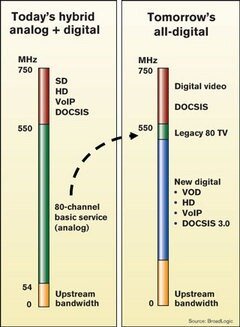 So Time Warner Cable is, rightfully, in the process of converting its cable signal from analog to digital, and in the process is carrying one of each version of the most popular channels. That’s hogging a lot of bandwidth! The letter we received is simply notifying us of the next wave of channels that will be taken off of the analog package of signals. Eventually all of the analog channels will be shut off, requiring every TV to have a digital tuner to receive the signal. This will allow companies to offer faster internet and more HD channels without radical infrastructure improvements.
What’s this CableCARD thing they mention?
Because some people in the 90s were fed up with the cable companies’ crappy cable boxes and numerous remote controls, the cable companies agreed on a standard key that could be inserted into the customer’s own equipment, allowing the customer to get all of the digital signals on his or her equipment. The CableCARD dream was for all TVs to have a slot where the key, the CableCARD, could be inserted, unlocking all of the channels and allowing the user to use the TV’s remote control to see the guide data and all of the channels. Unfortunately the cable companies’ agreement was simply to placate congress, and the companies did everything they could to make the CableCARD concept fail in the marketplace. They discouraged TV manufacturers from implementing the technology and they changed their own technology to make CableCARD incompatible with all offered channels and any on-demand items. CableCARD is still a great option though, allowing superior DVRs like Windows Media Center and Tivo to exist.
What about watching WRAL on 5.1, not with a box?
Ahh encryption. To circumvent piracy cable companies started encrypting their signals, which requires even more specialized equipment to receive and decode the signals. Time Warner’s boxes and DVRs do all of this behind the scenes work for the customer. Currently all channels above 99 are encrypted, and require a Time Warner box or CableCARD to decode the signal, not just receive it. Until October, however, federal law stipulated that cable companies could not encrypt signals that were also available over-the-air, ie in the public domain. This meant that cable companies had to provide channels like WRAL, WTVD, PBS, etc to all customer TV sets without requiring special equipment (“in the clear”). This allowed customers who don’t want a Time Warner cable box to scan the channels and get HD signals for WRAL on 5.1, for example, instead of just watching the SD signal on channel 3.
Not anymore. On October 12, 2012, the FCC ruled that cable companies are allowed encrypt our local stations, requiring customers to have their special equipment to tune content that is also carried via the public trust of the airwaves. Time Warner Cable has made no reference to this and has not stated any intention of requiring equipment to tune the major networks, however the gate is open for them to do so, which would disable customers’ abilities to tune WRAL-HD with their TVs on 5.1.
I’m just going with U-Verse or satellite
We certainly have options these days, which is great, but Time Warner Cable remains the only option that currently doesn’t require a settop box at every TV, allowing customers to tune programming with the TV’s integrated tuner. My prediction, however is that supplier’s logic will trump market demand and we will all have to have a converter box on every TV regardless of provider.
I’m pulling the plug and going with AppleTV
Apple, Google, Microsoft, Netflix, Hulu, Roku, Boxee, etc are all trying to figure this out. Currently these companies offer equipment that users plug into the internet and to their TV. While these boxes do use the internet provider’s pipes, they pull their content from sources other than Time Warner Cable. Unfortunately they don’t currently provide the content most users want. Live sports, live news, the latest movies, and the most popular TV shows are difficult to find through these services, and will continue to be as long as cable and satellite providers hold on to content for dear life. Eventually these challengers will win, and companies like Time Warner Cable will continue to thrive as metered internet providers, as will as internet-based video providers. The concept of a live stream that offers shows at certain times will be a thing of the past, and local TV stations will have no role other than as local news agencies. However that day is still a long, long time coming.
If you are interested in sports, pulling the plug will definitely leave you very disappointed. The content offered outside of the mainstream providers is still too scant for most people. These alternative companies are definitely on to something, but the current model of delivering video content to customers is here to stay for quite a while longer.
-
Anonymous
-
Anonymous
-
Anonymous
-
Anonymous
-
Anonymous
-
Anonymous
-
Guest
-
JohnP
-
-
-
Anonymous
-
-
Nick
-
-
Burgeoningfoodie
-
Anonymous
-
Matt
-
-
-
Drr2
-
dennis
Recent Stories
- North Carolina Loses The Great Teacher February 9, 2015
- City Lays Markings for Currituck Obstacle Course February 4, 2015
- History Making Heels and Wolfpack Prepare for Battle January 14, 2015
- 25 Predictions for 2015 January 5, 2015
- Raleigh’s 10 Biggest Stories of 2014 January 2, 2015
- 2014: The Rain Year January 2, 2015
- Tupelo Honey Sets New Casual Standard December 1, 2014
- 2013 Predictions. A Look Back November 18, 2014
- Wicked Taco Bringing Fresh-Mex to Western Blvd November 17, 2014
- DOT Unveils I-440 Widening Plans November 12, 2014
- County Power Shift Brings Major Changes to Raleigh’s Future November 5, 2014
- Jarrett Bay Store Coming to Crabtree September 25, 2014
- FirstWatch Coming to Glenwood Avenue September 9, 2014
- Big Shindig Releases Set Times September 5, 2014
- Appearance Commission to Review Residence Inn September 3, 2014


